HUS has started implanting prosthetic aortic valves through carotid artery access
Keywords:HUS Heart and Lung Center is now ready to implant prosthetic aortic valves using the patient’s carotid artery in the neck as an access point if the traditional implantation via the groin is not possible.
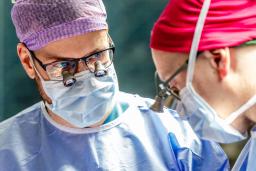
Of all TAVI procedures performed at HUS, about three to five percent can be performed through the carotid access in future.
Transcatheter aortic valve implantation (TAVI) is a procedure in which a new, functional aortic valve prosthesis is delivered through a blood vessel and placed inside the patient’s diseased aortic valve using a catheter.
The implantation can be done through the carotid artery in the neck when the usual groin access is not possible. Reasons for this may include narrowing or calcification of the arteries in the lower limbs. Prior to the procedure, doctors must ensure that the blood flow to the cerebral and carotid arteries is adequate.
Carotid artery access used in three to five percent of all TAVI procedures
Of all TAVI procedures performed at HUS, about three to five percent can be performed through the carotid access in future. Internationally, the carotid access route is emerging as the primary option in cases where groin access cannot be used. Studies show that implantations performed through the carotid access are just as safe as those performed through the groin access.
In the early years of TAVI procedures, alternative access routes included approaches through the ascending aorta or the apex of the heart. However, studies have shown these approaches to be more risky and significantly more invasive. They are used only if no artery access route is available.
For the past four years, HUS has mainly used the subclavian artery as the alternate access route. The problem with this access route was that the subclavian artery is fragile and hard to reach. Use of the subclavian route involved anticipating complications and often performing additional procedures due to bleeding.
“The newly adopted carotid artery access route appears to be a viable and safe option when we cannot use the groin access for valve implantation,” says Sebastian Dahlbacka, specialist in cardiac surgery at HUS Heart and Lung Center.