EUHA Symposium: Staff wellbeing is a prerequisite for sustainable healthcare
The Inspired Professionals symposium, held in connection with the EUHA Members’ Assembly at HUS, highlighted the importance of skilled and motivated professionals in the future of healthcare.
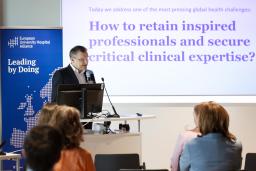
In the morning, the symposium featured presentations by three keynote speakers, and in the afternoon participants split into four smaller groups to discuss the morning sessions and share their experiences.

The first keynote address was delivered by Tomas Zapata, Unit Head of Health Workforce and Service Delivery at the WHO Regional Office for Europe. In his presentation, he examined the availability of the healthcare workforce, the mobility of healthcare professionals in Europe, the challenges of the current situation, and the impact of mobility on healthcare systems.
According to projections, Europe will face a shortage of around 940,000 healthcare workers by 2030. The shortage is driven by the ageing of the current workforce, a preference for part-time work, mental health challenges, and professionals moving into other roles. At the same time, demand for services is increasing, among other reasons because of population ageing.
Zapata noted that a study conducted in 29 countries showed that different mental health problems are quite common among healthcare professionals. “We must take these mental health problems very seriously. At the same time, two thirds of doctors and nurses find their work meaningful and are satisfied with it,” Zapata said. Leadership has a major impact on staff wellbeing. Doctors and nurses who have more opportunities to influence their work report less depression and anxiety.
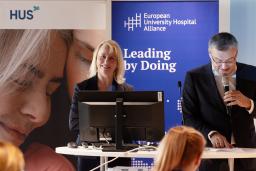
The second keynote address was delivered by Nina Forss, Director of the HUS Neurocenter. In her presentation, she shared the Neurocenter’s experiences of how highly specialized clinical experts can be identified, supported in their development, and encouraged to remain motivated and committed.
The Neurocenter has had positive experiences in “growing its own professionals”: students are introduced to clinical work at an early stage and offered low-threshold opportunities to engage in research. Residents are also supported in conducting research alongside their clinical work. “Doing research provides important competencies for clinical work. It develops critical appraisal skills, strengthens the ability to evaluate new research findings, and can accelerate the adoption of new treatment methods,” Forss said.
The third keynote address was delivered by Kari Reijula, Professor Emeritus of Occupational Health and Occupational Medicine at the University of Helsinki. In his presentation, he discussed the mental and physical strain factors involved in hospital work and how occupational health services and work organization together can support staff wellbeing and work ability. He also emphasized the importance of staff wellbeing for the functioning and performance of the hospital as a whole. “Employee wellbeing and work ability are built through cooperation between three parties: the employer, occupational health services, and employees. The cornerstones of occupational health are risk assessment, preventive action, the diagnosis of occupational diseases, and work ability assessment,” Reijula said.
“The discussions at the symposium highlighted a shared understanding that the challenges are largely similar across all university hospitals. That is precisely why sharing experiences, lessons learned and good practices is so important — together we can strengthen staff wellbeing, work ability and the sustainability of healthcare as a whole,” says Matti Bergendahl, CEO of HUS.