An emergency physician is the jack-of-all-trades of the emergency department
When a patient is in distress, Robert Östman knows what to do. A newly certified specialist in acute medicine is skilled in the assessment and diagnosis of urgent medical conditions, ensuring that treatment is initiated efficiently and safely.
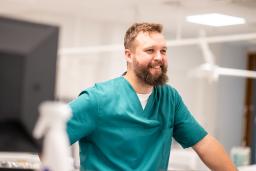
An emergency physician is an expert in countless different health issues. What fascinates Robert Östman about acute medicine is the need to master a wide range of skills and to be familiar with many different specialties.
Robert vividly recalls an incident that occurred during his internship, in which a patient lying in the emergency department’s procedure room began to have difficulty breathing and their condition deteriorated. “I had just started my internship and was working alongside two experienced nurses. The patient’s symptoms seemed difficult to manage, and I noticed that the nurses could sense my uncertainty. I could feel the tension rising.”
Suddenly, the door to the room opened, and a calm and cheerful acute medicine physician walked in. Everyone’s shoulders relaxed instantly. “That’s when—if not before—I realized that I wanted to be the kind of person whose presence brings a sense of support and security when they walk in. I wanted to learn how to take control of situations and help every patient in the best way possible,” Robert says.
It’s been years now since the internship. Robert completed his specialist training in acute medicine last summer. He currently works on a rotating weekly basis as a senior ward physician at Meilahti Emergency Department and as the chief physician at the Porvoo Hospital Emergency Department.
Urgent diagnostics and treatment
An acute medicine physician is a specialist in the diagnosis and treatment of urgent health problems. Work that crosses the boundaries of traditional specialties is usually carried out in the emergency department—the most diverse and fast-paced setting in a hospital.
What fascinates Robert about acute medicine is the need to master a wide range of skills and to be familiar with many different specialties. “Acute medicine physicians are involved in the care of all patient groups in the emergency department. For example, when a heart attack is found to be the underlying cause of abdominal pain, I know how to manage the situation holistically. I’m able to act as a sort of interpreter between different specialties and come up with solutions quickly.”
Collaborative teamwork
Most patients arrive at the emergency department on their own and are discharged home or referred for further care within about four hours. In addition to assessing the need for treatment and performing blood tests, emergency department visits typically involve various types of procedures, such as suturing wounds, inserting cannulas, catheterization, performing punctures, and taking imaging scans.
When prehospital emergency services bring a patient in an acute emergency to the emergency department, the patient is often received by an acute medicine physician and at least two nurses. If necessary, additional nurses, specialists, and imaging and laboratory experts will be called in. The work is based on multidisciplinary collaboration, in which everyone has a clearly defined role.
“Teamwork among experts from different fields is truly rewarding. As an acute medicine physician, my job is rewarding in the sense that I’m able to adapt to a wide variety of situations that come my way and take the necessary actions. Once the diagnostics have progressed, I consult with a specialist in the appropriate field to continue treatment,” Robert says.
Management of emergency care services as a whole
In addition to working with patients, Robert’s workdays include planning, supervising, and training of emergency services. The day often begins with meetings and paperwork.
“I usually start my morning at the computer, and then I go to assist our specializing physicians as needed.” We often see patients together and plan their care as part of larger teams,” Robert says.
There is plenty to coordinate: for example, the Meilahti Emergency Department has representatives from sixteen medical specialties, and more than 300 patients may come in during the course of a day.
“It’s truly interesting to develop combined emergency services in a situation where our specialty, which is only 12 years old, has already come such a long way. As our importance is growing so rapidly, where will we be in ten years? I believe that in the future, every emergency department will always have at least one acute medicine physician on site who, as a jack-of-all-trades in the emergency context, can support junior physicians and find the best solutions for patients,” Robert says.
Learn more about acute medicine at HUS
View open specialist positions at HUS